The Circle of Knowledge
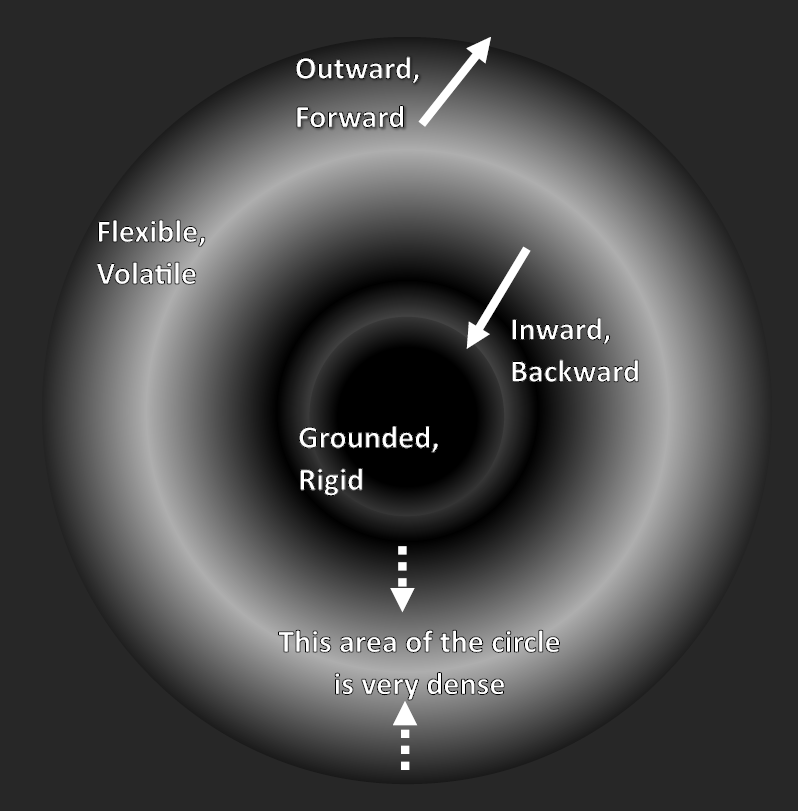
People can be classified in terms of their relationship with the truth into two groups. The mapping of the two groups give us the shape of a circle, with some people closer to the center, others closer to the edge, and the majority in-between.
Here is the criteria:
Inward vs. Outward = where truth is sought
Backward vs. Forward = time orientation of that search
The axes describe tendencies, not fixed positions; most people occupy unstable combinations that shift over time.
| Group I: Inward + Backward | Group II: Outward + Forward |
|---|---|
| They look for the truth within themselves, and/or in inherited truth systems.They are close to the center of the circle where there is certainty and people are grounded.At the center ideas have been tested for thousands of years. They are stable, but also rigid. What makes the center stable also makes it resistant to correction and change. Also, certainty does not indicate truthfulness, and stability is not an indicator of correctness. | They look for the truth outside of themselves and into the future or the unknown.They are closer to the edge where there’s high volatility, but also high flexibility.There are more unknown than there are known truths.Ideas at the edge are provisional and frequently overturned. Progress comes through error, not certainty.Life at the edge requires tolerance for doubt and frequent revision of beliefs. Identity there is more fluid, but also more fragile. |
Scientists are on the very edge of the circle. They’re the ones who expand the circle of knowledge. Philosophers are also on the edge of the circle along with scientists, but they use different search tools. They are more forward-looking but less outward. Scientists and philosopher are pulled inwards by institutions, methods, and systems.
Most people are somewhere between the two extremes. The closer someone is to the center or the edge, the stronger the pull that keeps them there.
The Shared Value
People at the very center and edge have one thing in common: their lives are centered around seeking the truth. They think that seeking the truth is the value they add to life, and it’s their duty and assigned role. The difference between them is the direction of the search.
It’s Dynamic, Sort of
It’s rare for someone to travel far in the circle. We all start our lives at some point in the circle based on our culture, family, geography and many other factors. We explore the area around that point and end up most probably close to where we started.
The exception is people at the very center and edge. These are the ones who are more likely to venture away from where they started. People in the center are grounded, which makes it easier for them to venture away without much anxiety, but venturing away from the center is extremely risky. People at the edge can also venture away because they are used to and accepting of uncertainty and unpredictability.
Movement costs
– identity, by crushing the story of who you are.
– risks social penalty, when you become the black sheep.
– self-image, by admitting past errors.
What belief have you let go of because it became psychologically costly or internally conflicting to keep?
The Missing Piece
There are people outside the circle. They simply don’t care about the truth, let along finding it. These people are usually happy, or so they seem. Whether their apparent happiness is freedom or avoidance remains an open question.
The Question
What was your journey in the circle so far, what would it cost you to move, and what are you protecting by staying where you are?